The Catizona Cattler
Arizona Bankruptcy Myths (2026): What's Actually True?
Louis Interviews The Dark Whisker at the Whisker Lair
Reviewed by Jeff A. Biddle, Arizona bankruptcy attorney — Last checked November 20, 2026
Serving Chandler and the Phoenix metro area

Jump to the Myth vs. 2026 Arizona Law table ↓
Jeff Biddle Law helps people across Chandler and the Phoenix metro area, and these are the myths we hear most. The elevator hidden behind the tall bookshelf at Jeff Biddle Law only goes one way: down. When the doors slid open, a giant paw-shaped spotlight flickered across the cave ceiling, six monitors hummed over a wall of towering scratching posts, and The Dark Whisker stood in front of a glowing board labeled MYTHS vs. STATUTES.
"Dark Whisker," I said, clicking my pen, "the internet says bankruptcy takes everything you own, ruins your credit forever, and tells the whole neighborhood."
He didn't even blink behind his mask. "The internet also says cats hate water, Louis. Let's check the evidence."
What Are the Short Answers?
1. Louis: Do you lose your house and car if you file bankruptcy in Arizona?
The Dark Whisker: Not automatically. Arizona protects home equity up to a cap—about $437,600 for 2026 as calculated under the statute's formula—and equity in one vehicle up to about $16,500 (or about $27,500 if the debtor or a dependent has a physical disability), also calculated for 2026. Exemptions protect equity, not total value, and they don't stop a lender from foreclosing or repossessing if payments stop.
2. Louis: What about retirement savings?
The Dark Whisker: Generally protected under Arizona and federal law, with an important timing catch: amounts contributed within 120 days before filing aren't protected under Arizona's statute.
3. Louis: Does Chapter 13 force you to pay back 100% of every debt?
The Dark Whisker: No. Chapter 13 is a payment plan sized to your income, expenses, non-exempt property, and the kinds of debt you owe—not a blanket 100% payback pledge.
4. Louis: Can back income taxes ever be discharged?
The Dark Whisker: Sometimes, if older income taxes pass every timing and filing rule (the "3-2-240" checklist). Trust-fund and withholding taxes are a different story and don't get wiped out.
5. Louis: Can you file if you filed bankruptcy before?
The Dark Whisker: Yes, but to get a new discharge you generally have to wait 8, 4, 6, or 2 years depending on the chapters, counted from the filing date of the earlier case to the filing date of the new one.
6. Louis: Will everyone find out, does bankruptcy stop garnishment, and what about my spouse?
The Dark Whisker: Filings are public court records, but the court doesn't announce them. The automatic stay pauses most consumer wage garnishments (not child support). Arizona is a community-property state, so community property can be pulled in even if only one spouse files. Talk to a lawyer before deciding whether to file alone or together.
7. Louis: Is there a minimum amount of debt to file?
The Dark Whisker: None. The Bankruptcy Code has a ceiling for Chapter 13, not a floor.
8. Louis: Does bankruptcy ruin your credit for life?
The Dark Whisker: No. Federal law sets a 10-year reporting ceiling from the filing, and many lenders have defined waiting periods—often two to four years depending on the loan program—after discharge.
Myth 1: Will I Lose My Home and Car in an Arizona Bankruptcy?

Louis: Let's start with the scariest one. A 2022 Arizona blog I found says the homestead exemption is $250,000. Another site says you lose everything.
The Dark Whisker: Outdated intel, Louis. Pull up Monitor One.
Arizona's homestead statute prints a base amount of $400,000, and it adjusts every January 1 using the federal Consumer Price Index (CPI-U), rounded up to the nearest $100. Because no Arizona agency publishes the adjusted number, the 2026 figure—about $437,600 as of January 1, 2026—is calculated under the statute's formula. That number changes again every January.
And remember the golden rule of the Lair: the homestead protects your equity, not the home's total value. Equity is what the home is worth minus what's owed on mortgages and liens. If your equity is within the cap on the day you file—the petition date—Arizona law (for cases filed after the 2025 update) says the home is protected, and increases in value during the bankruptcy case stay protected too.
Louis: So the mortgage company can't touch it?
The Dark Whisker: Careful. An exemption protects your equity from other creditors, not from the mortgage lender. If the payments stop, the lender can still foreclose. And the homestead doesn't double for a married couple—it's one homestead per single person or married couple.
Louis: What if someone lives in an RV or a houseboat?
The Dark Whisker: Big Arizona update there. In 2024, the Arizona Supreme Court ruled in In re Drummond that a motor home didn't count as a homestead. In 2025, the Arizona Legislature passed SB 1540 to override that ruling. For cases filed after SB 1540's 2025 effective date, Arizona's homestead explicitly covers a house, condo, co-op, mobile home, manufactured home, park model, motor home, travel trailer, fifth wheel, or houseboat, plus the land under it. The catch: you actually have to live in it as your residence. A vacation RV you don't live in isn't a homestead. (And if you acquired your home equity within 1,215 days before filing, a federal cap of $214,000 can apply, with an exception for equity rolled over from a prior Arizona home.)
Louis: What about the Batmobile—I mean, the family car?
The Dark Whisker: Arizona protects equity in one motor vehicle. The statute prints a base of $15,000—or $25,000 if the filer or a dependent has a physical disability—and adjusts it every January with CPI-U. As of January 1, 2026, that comes to about $16,500, or about $27,500 with a qualifying physical disability, calculated under the statute's formula. Just like with a home, it protects equity, not total value, and it doesn't stop a lender from repossessing if car payments stop. What happens with a financed car depends on the loan, the equity, and whether you file Chapter 7 or Chapter 13.
One more twist for married couples: while the homestead never doubles, Arizona's personal property exemptions (like household goods, clothing, bank accounts, and vehicle exemptions) belong to each spouse individually, and spouses can combine them on the same asset or use them on different ones. For the full 2026 exemption breakdown, see our Money Matters 2026 "What Can I Keep?" column, and for cars specifically, check out Purr-tect Your Wheels.
Arizona exemption amounts, as of January 1, 2026
| Property | Statute base amount | 2026 amount | A.R.S. cite |
|---|---|---|---|
| Homestead equity | $400,000 | $437,600 (calculated under the statute's CPI formula) | § 33-1101 |
| Equity in one motor vehicle | $15,000 | $16,500 (calculated) | § 33-1125(8) |
| Equity in one motor vehicle, physical disability of debtor or dependent | $25,000 | $27,500 (calculated) | § 33-1125(8) |
| One bank account at one financial institution | $5,000 | $5,600 (calculated) | § 33-1126(A)(9) |
| Tools of the trade (combined fair market value) | $5,000 | $5,000 (printed in the statute; no yearly adjustment) | § 33-1130(1) |
2026 amounts are our calculation, adjusting each year's amount by the August-to-August CPI-U change and rounding up to the nearest $100 as the statutes direct; no Arizona agency publishes them. For the full list, see our Money Matters 2026 exemption table. Last checked November 20, 2026.
Myth 2: Will I Lose My Retirement Savings in Bankruptcy?

Louis: Next file on the board: people draining their 401(k) or IRA to pay credit cards because they think bankruptcy will wipe out their nest egg.
The Dark Whisker: That's one of the costliest mistakes people make. Many people talk to a bankruptcy lawyer before cashing out or borrowing from retirement accounts, because doing so can change what's protected.
Under both Arizona law and federal bankruptcy law, qualified retirement accounts—including 401(k)s, 403(b)s, 457 plans, traditional IRAs, and Roth IRAs—are generally protected from creditors. Some older web pages say retirement is protected "as long as it's an ERISA plan" and lump IRAs in with 401(k)s. Technically, ERISA-qualified employer plans with the standard anti-alienation clause stay out of the bankruptcy estate altogether under federal law (as the U.S. Supreme Court confirmed in Patterson v. Shumate), while individual retirement accounts (IRAs) generally aren't ERISA plans—they're protected through the federal and Arizona exemption statutes instead.
Louis: There's always a trapdoor in the Lair. What's the catch here?
The Dark Whisker: Timing. Under Arizona law, amounts contributed within 120 days before filing bankruptcy are not exempt. A last-minute lump-sum deposit right before filing can lose its shield. Recent contributions are one of the first things a bankruptcy lawyer checks.
Myth 3: Does Chapter 13 Mean Repaying 100% of Everything?

Louis: Hold on—what is that blinking radar dish on the workbench?
The Dark Whisker: The Disposable-Income-Detector. People hear "Chapter 13 repayment plan" and assume they have to pay every single credit card and medical bill in full. That's rarely how the math works.
A Chapter 13 plan generally runs three years for filers below the state median income and five years for filers at or above it—and it can't run longer than five. Certain debts—like priority claims such as recent income taxes, or catching up on past-due mortgage payments if you're keeping the house—do have to be handled through the plan. For general unsecured debts like credit cards and medical bills, though, the Bankruptcy Code uses two main tests:
- The best-interests test: Unsecured creditors must get at least as much as they would have received in a Chapter 7 liquidation.
- The disposable-income test: If the trustee or an unsecured creditor objects, the plan must either pay that creditor in full or commit your projected disposable income—what's left after reasonable, allowed expenses—for the applicable commitment period.
What unsecured creditors actually receive depends on your income, expenses, non-exempt equity, and debt mix. Many Chapter 13 filers pay general unsecured creditors only a portion of what's owed, and eligible remaining balances are wiped out at discharge.
Louis: And what if someone is behind on their mortgage—does Chapter 13 force the bank to rewrite the loan?
The Dark Whisker: No court can force a lender to modify a mortgage. What Arizona does have is the District of Arizona's Mortgage Modification Mediation (MMM) Program, run under General Order 23-2 (as amended by General Order 23-4). Think of it as a court-run negotiation room where the homeowner and lender try to work out a modification. No one can be forced into a modification—both sides have to agree, and the court has to approve any deal—and it isn't Chapter 13-only anymore: it covers individual cases in Chapters 11, 12, and 13, and Chapter 7 cases filed on or after July 1, 2023. (We walk through the whole program in our MMM Cafe post.)
Chapter 7 vs. Chapter 13 at a glance
| Topic | Chapter 7 | Chapter 13 |
|---|---|---|
| What it does | Eligible debts are wiped out; non-exempt property, if any, can be used to pay creditors. | A three-to-five-year payment plan sized to income, expenses, non-exempt property and debt types. |
| Who qualifies | Generally must pass the means test, which compares your income to Arizona's median for your household size. Above the median, you may still qualify after allowed expenses. | Individuals with regular income and combined noncontingent, liquidated debts of less than $2,750,000, for cases filed on or after November 10, 2026. |
| Behind on a house or car | Doesn't help you catch up on payments. | Can catch up past-due mortgage payments through the plan if you are keeping the house. |
| Court filing fee | $338 | $313 |
| Wait for a new discharge | 8 years after a prior Chapter 7 (filing date to filing date). | 2 years after a prior Chapter 13 (filing date to filing date). |
| Credit reporting | Up to 10 years from filing. | Up to 10 years from filing (7 years is bureau practice, not a statute). |
Court fees as of November 20, 2026. See A Whirlwind Date with Chapter 7 and A Long-Term Relationship with Chapter 13.
Myth 4: Can Back Taxes Ever Be Discharged in Bankruptcy?

Louis: I see a vault door over there with three giant brass locks. Is that where you keep the catnip?
The Dark Whisker: That's the 3-2-240 vault—the checklist for discharging older income taxes. People hear "taxes can never be wiped out" and give up. In reality, older federal or state income taxes can sometimes be discharged in Chapter 7 or treated like general unsecured debt in Chapter 13, if every lock opens:
- The 3-year rule: The tax return was last due (including extensions) more than three years before the bankruptcy filing date.
- The 2-year rule: The return was actually filed more than two years before the filing date.
- The 240-day rule: The tax was assessed more than 240 days before the filing date (and isn't a tax that can still be assessed).
- No fraud or evasion: The return wasn't fraudulent, and there was no willful attempt to evade the tax.
Certain events—like an earlier bankruptcy case, a pending offer in compromise, or a collection-due-process appeal—can pause these clocks and extend them. And a return that was never filed generally keeps the tax from being discharged.
Louis: What taxes stay locked tight?
The Dark Whisker: Trust-fund and withholding taxes—taxes a business collected or withheld for the government—are priority debts and aren't discharged, no matter how old they are. And even when personal liability for an older income tax is discharged, a tax lien recorded against your property before filing can still survive on that property. Because exact transcript dates make or break tax dischargeability, Jeff checks official tax transcripts before making any call. (For the full deep dive, see Don't Let the Tax Man Take Your Tuna.)
Myth 5: Can I File Bankruptcy Again If I Filed Before?
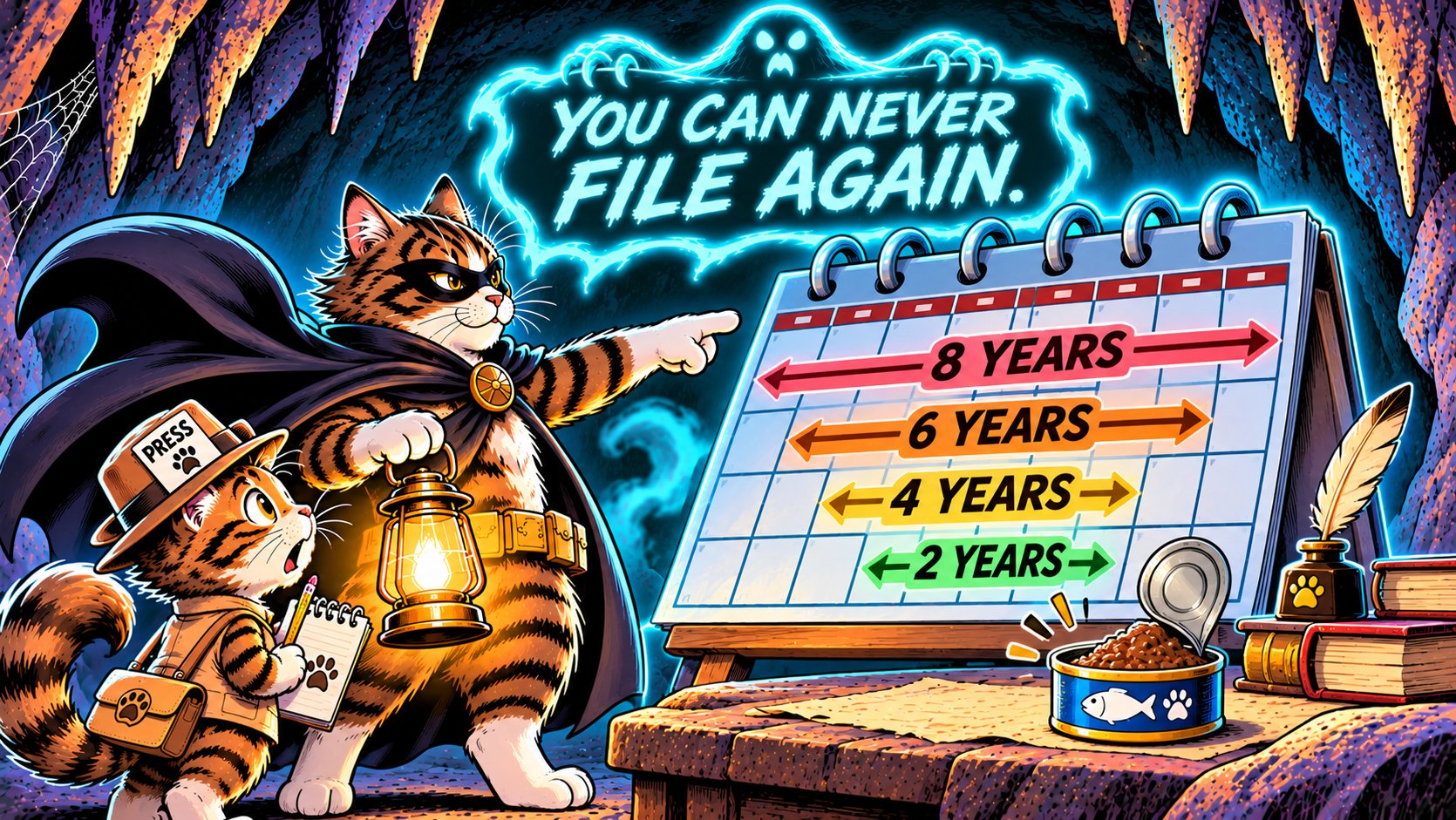
Louis: Next to the vault is a huge calendar covered in paw-print stickers.
The Dark Whisker: The repeat-filer clock. You aren't limited to one bankruptcy in your lifetime. The Bankruptcy Code sets waiting periods to receive a new discharge, and every single one is measured from the filing date of the first case to the filing date of the new case—not from the discharge date.
| Prior case (with discharge) | New case | Waiting period for a new discharge |
|---|---|---|
| Chapter 7 | Chapter 7 | 8 years |
| Chapter 7 (or 11 or 12) | Chapter 13 | 4 years |
| Chapter 13 | Chapter 7 | 6 years (unless the prior plan paid 100% of allowed unsecured claims, or at least 70% with good faith and best effort) |
| Chapter 13 | Chapter 13 | 2 years |
Louis: Wait—you said waiting periods for a discharge. Can someone file sooner without one?
The Dark Whisker: Sometimes. Lawyers informally call it a "Chapter 20" when someone finishes a Chapter 7 and files a Chapter 13 fewer than four years later. They won't get a Chapter 13 discharge, but the U.S. Supreme Court confirmed in Johnson v. Home State Bank that a mortgage lien surviving a Chapter 7 discharge can still be dealt with in a Chapter 13 plan. A plan can also pay priority and non-dischargeable debts such as certain taxes and support.
Two serious warnings on repeat filings, though: if a prior case was dismissed within the last 180 days for willful failure to follow court orders or voluntarily dismissed after a creditor asked to lift the stay, you may be barred from filing at all during that 180-day window. And if you had one prior case dismissed within the past year, the automatic stay generally ends after 30 days unless the court extends it; with two or more dismissals in the past year, no automatic stay kicks in at all unless the court orders one.
Myth 6: What About Garnishment, Privacy and Your Spouse?

Louis: Next screen on the cave wall, Dark Whisker. Three quick Arizona myths people bundle together: wage garnishment, privacy, and marriage.
The Dark Whisker: Let's clear all three before the bat-coffee gets cold.
Will Bankruptcy Stop Wage Garnishment in Arizona?
Filing triggers the automatic stay—think of it as the Lair's force field. It immediately pauses most collection actions, including most wage garnishments for ordinary consumer debts. Child support and spousal maintenance withholding, however, passes right through the force field. (And outside bankruptcy, Arizona's Proposition 209 caps ordinary wage garnishment at the lesser of 10% of weekly disposable earnings or the amount above 60 times the highest applicable minimum hourly wage—not the higher pre-Prop 209 percentage still floating around on stale websites.)
Will Everyone Find Out I Filed Bankruptcy?
Bankruptcy filings are public court records, searchable through the federal PACER system, so nobody should promise "no one will ever know." At the same time, the court doesn't run a public announcement or put your name on a billboard. In Chapter 13, an employer can learn about the case if payments are sent through a court wage order.
What Happens to My Spouse If I File Bankruptcy in Arizona?
Arizona is a community-property state: property acquired during marriage is generally community property. That means even if only one spouse files, community property can still be pulled into the bankruptcy estate. On the flip side, federal law includes a community discharge that generally protects community property acquired after filing from most community debts (with important statutory exceptions). What it does not do is erase the non-filing spouse's own personal liability on joint or co-signed debts, or protect the non-filing spouse's separate property. What happens to a spouse depends on the facts, so it's a question for a lawyer before deciding whether to file alone or together.
Myth 7: Do I Have Enough Debt to File Bankruptcy?

Louis: What if someone thinks they owe "too little" to walk into bankruptcy court?
The Dark Whisker: There is no minimum debt amount in the Bankruptcy Code. The law sets a ceiling for Chapter 13, not a floor.
In fact, Congress just updated that ceiling. Under the Bankruptcy Threshold Adjustment Act (Pub. L. 119-142, signed November 10, 2026), for Chapter 13 cases filed on or after November 10, 2026, an individual (or married couple) must have combined noncontingent, liquidated debts of less than $2,750,000—replacing the older separate caps for secured and unsecured debt.
Whether filing makes sense for a smaller debt load isn't about a legal minimum. It's a practical question: your income, your expenses, whether bankruptcy fits your situation, and the real-world cost (as of November 20, 2026, court filing fees alone are $338 for Chapter 7 and $313 for Chapter 13, plus required pre-filing credit counseling within 180 days before filing).
One more thing: Chapter 7 does have an income test. If your average income over the six months before filing is above Arizona's median for your household size, the means test then subtracts allowed expenses, and you may still qualify. Jeff checks this first.
Myth 8: Does Bankruptcy Ruin Your Credit Forever, and Can You Still Get a Mortgage?

Louis: Okay, this is the one everyone whispers about. Ten years with zero credit and no house, right?
The Dark Whisker: Separate the three clocks, Louis. People mash them together all the time.
- Clock 1 — Credit reporting: Under the federal Fair Credit Reporting Act, a credit bureau may report a bankruptcy for up to 10 years from the order for relief (the filing date). That 10-year limit is the statutory ceiling for any chapter. (Federal law does carve out exceptions for very large credit transactions or life insurance of $150,000 or more and jobs paying $75,000 or more.) You'll often hear that Chapter 13 drops off after 7 years—that's credit-bureau practice, not a requirement written into the statute.
- Clock 2 — Everyday credit: Filing doesn't make credit impossible for ten years; what a lender offers depends on its own rules. (If you're in an active Chapter 13 plan, ask your lawyer before taking on new debt.)
- Clock 3 — Mortgages: Mortgage waiting periods are set by loan programs, not the Bankruptcy Code, and they generally run from discharge or dismissal, not filing. For conventional loans, Fannie Mae's published Selling Guide sets a 4-year wait after a Chapter 7 discharge or dismissal (2 years with documented extenuating circumstances), and 2 years after a Chapter 13 discharge—or 4 years after a Chapter 13 dismissal. Government-backed loans like FHA and VA are commonly reported to have shorter waits on certain paths (such as two years after a Chapter 7 discharge, or applying after 12 months of on-time Chapter 13 payments with court permission). Other conventional programs, including Freddie Mac's, set their own periods. Individual lenders add their own rules, so confirm current guidelines with a lender.
Practical habits still matter after filing: many people check their credit reports to make sure discharged debts show as discharged and focus on paying every new bill on time.
Myth vs. 2026 Arizona Law: What Does the Evidence Board Say?
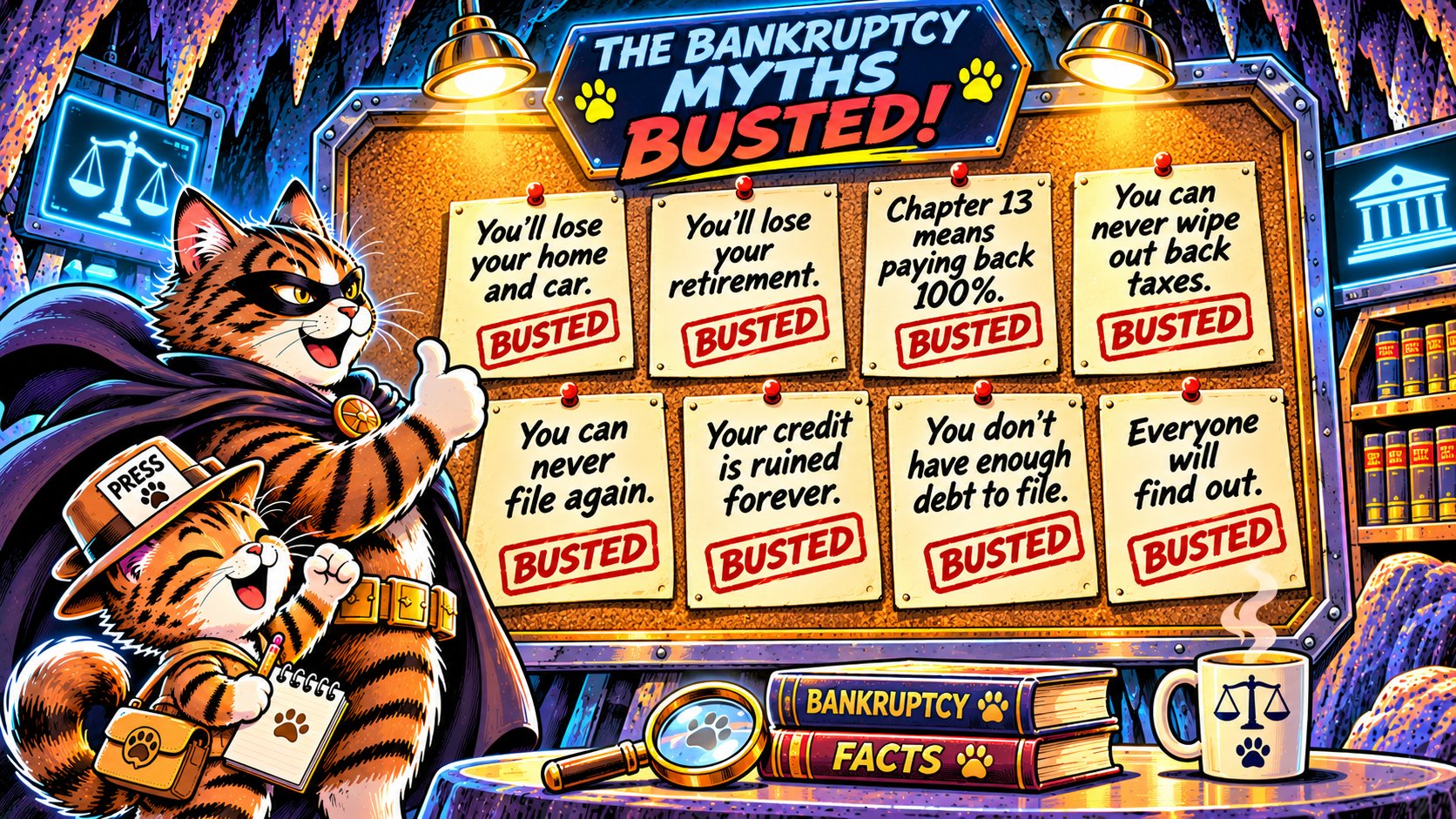
Louis: Give me the headline version for the Catizona Cattler.
The Dark Whisker: Here's what the statutes actually say, as of November 2026.
| Myth | What the law says | Where to look |
|---|---|---|
| 1. You'll lose your home and car | Arizona protects equity, not total value: about $437,600 for a homestead and about $16,500 for one vehicle (about $27,500 with a qualifying physical disability), calculated for 2026. Lenders can still foreclose or repossess if payments stop. | A.R.S. §§ 33-1101, 33-1125(8) |
| 2. You'll lose your retirement savings | Generally protected under Arizona and federal law, except contributions made within 120 days before filing under Arizona's statute. | A.R.S. § 33-1126(B); 11 U.S.C. §§ 522(b)(3)(C), 541(c)(2) |
| 3. Chapter 13 means repaying 100% | A plan sized to income, expenses, non-exempt equity and debt types. Not an automatic 100% payback. Plans run three to five years. | 11 U.S.C. §§ 1322, 1325 |
| 4. You can never discharge back taxes | Older income taxes may be dischargeable under the 3-2-240 rules. Withholding and trust-fund taxes are not. | 11 U.S.C. §§ 507(a)(8), 523(a)(1) |
| 5. You can't file again | Discharge waits are 8, 4, 6 or 2 years, measured filing date to filing date. Recent dismissals can limit the automatic stay. | 11 U.S.C. §§ 727(a)(8)-(9), 1328(f), 362(c)(3)-(4) |
| 6. Everyone will find out, it won't stop garnishment, and it wrecks my spouse | Filings are public court records, but there is no public announcement. The automatic stay pauses most consumer garnishments, but not child support or spousal maintenance withholding. Arizona is a community-property state, so community property can be pulled in; community discharge protects later-acquired community property from most community debts, with exceptions, and does not erase a non-filing spouse's own liability. | 11 U.S.C. §§ 107, 362, 524(a)(3), 541(a)(2); A.R.S. §§ 25-211, 33-1131 |
| 7. You need a minimum amount of debt | There is no minimum. Chapter 13 has a ceiling: less than $2,750,000 combined for cases filed on or after November 10, 2026. | 11 U.S.C. § 109(e); Pub. L. 119-142 |
| 8. Bankruptcy ruins your credit forever | Federal law caps credit reporting at 10 years from filing. Mortgage waits are set by loan programs and generally run from discharge or dismissal. | 15 U.S.C. § 1681c; Fannie Mae Selling Guide B3-5.3-07 |
Every case turns on its own dates, equity, and debt mix. Before you cash out a retirement account, move money, or assume you can't keep your home, call Jeff Biddle Law in Chandler and the Phoenix metro area at (480) 622-4987 and get the real numbers for your situation.
Frequently Asked Questions About Arizona Bankruptcy Myths
Will I lose my house and car if I file bankruptcy in Arizona?
Not automatically. Arizona protects home equity up to about $437,600 for 2026 and equity in one vehicle up to about $16,500 (about $27,500 with a qualifying physical disability), as calculated under the statute's formula. Exemptions protect equity, not total value, and they don't stop a lender from foreclosing or repossessing if payments stop.
Is my retirement account safe in an Arizona bankruptcy?
Generally yes. Qualified retirement accounts are generally protected under Arizona and federal law. The catch is timing: amounts contributed within 120 days before filing aren't protected under Arizona's statute.
Do I have to repay 100% of my debts in Chapter 13?
No. Chapter 13 is a three-to-five-year payment plan sized to your income, expenses, non-exempt property and the kinds of debt you owe. Many filers pay general unsecured creditors only a portion of what's owed.
Can back income taxes be discharged in bankruptcy?
Sometimes. Older income taxes can be discharged if they pass the 3-2-240 timing and filing rules and there was no fraud or evasion. Trust-fund and withholding taxes are not discharged.
Can I file bankruptcy again if I filed before?
Yes, but to get a new discharge you generally have to wait 8, 4, 6 or 2 years depending on the chapters, counted from the filing date of the earlier case to the filing date of the new one. Recent dismissals can also limit the automatic stay.
Will everyone find out if I file bankruptcy, and what happens to garnishment and my spouse?
Bankruptcy filings are public court records, but there is no public announcement. Filing starts the automatic stay, which pauses most wage garnishments for ordinary consumer debts, though not child support or spousal maintenance withholding. Arizona is a community-property state, so community property can be pulled into the case even if only one spouse files. A lawyer should look at your situation before you decide whether to file alone or together.
Is there a minimum amount of debt to file bankruptcy?
No. The Bankruptcy Code has no minimum amount of debt. Chapter 13 has a ceiling: combined noncontingent, liquidated debts of less than $2,750,000 for cases filed on or after November 10, 2026. Whether filing makes sense depends on your income, expenses and situation.
Does bankruptcy ruin my credit for life?
No. Federal law lets a credit bureau report a bankruptcy for up to 10 years from filing. Mortgage lenders set their own waiting periods, often two to four years after discharge depending on the loan program.
Keep reading
- Money Matters: What Can I Keep in Arizona Bankruptcy? (2026)
- Behind on Car Payments in Arizona? Chapter 13 Can Generally Help You Keep Your Car
- Can Mortgage Mediation in Chapter 13 Lower Your Payment in Arizona?
- A Whirlwind Date with Chapter 7
- A Long-Term Relationship with Chapter 13
- The Debting Game: Chapter 7, Chapter 13, or a Debt Program?
- All Bankruptcy Cats blog posts

Flare Explains
Flare, Ember's kitten, breaks down the big words, in the order they appear in the column.
Equity: What property is worth minus what is still owed on it. Exemptions protect equity, not total value.
Exemption: A rule that protects a certain kind of property, up to a set limit, from creditors and from being sold in a bankruptcy case.
Homestead: The Arizona exemption for the home a person lives in—including a house, condo, mobile home, motor home, travel trailer, fifth wheel, or houseboat used as a residence.
Petition date: The exact day a bankruptcy case is filed. Many bankruptcy clocks and values are measured from this date.
Chapter 7: A bankruptcy case where eligible debts are wiped out and non-exempt property (if any) can be used to pay creditors.
Chapter 13: A bankruptcy repayment plan lasting three to five years, sized to a person's income, expenses, and assets.
Priority claim: A special kind of debt—like certain recent taxes or support—that a Chapter 13 plan generally has to pay in full.
Best-interests test: The Chapter 13 rule that unsecured creditors must receive at least as much as they would have gotten in a Chapter 7 case.
Disposable income: The money left each month after reasonable, allowed living expenses, which helps set a Chapter 13 plan payment.
Discharge: The court order wiping out a person's personal legal responsibility to pay covered debts.
Mediation (MMM): Arizona's court-run Mortgage Modification Mediation program, where a homeowner and lender try to agree on a loan change; nobody can be forced.
Assessment: The date the tax agency formally records how much tax is owed—one of the clocks in the 3-2-240 tax rule.
Trust-fund tax: Taxes collected or withheld for the government, such as payroll withholding taxes. These don't get wiped out in bankruptcy.
Waiting period: Either the time between bankruptcy filings to get a new discharge, or the time a mortgage lender requires after a bankruptcy. They are different clocks.
Automatic stay: The court-ordered pause that kicks in the moment a bankruptcy is filed, stopping most collection calls, lawsuits, and garnishments.
Garnishment: A court process that lets a creditor take part of a paycheck or bank account to pay a debt.
Disposable earnings: The part of a paycheck left after legally required deductions like taxes. Garnishment limits are figured from this number.
Community property: In Arizona, most property acquired by either spouse during a marriage belongs to both spouses together.
Community discharge: After the filing spouse gets a discharge, most creditors with community claims (debts both spouses' community property could be liable for) are blocked from collecting them from community property acquired after the case was filed. Some debts are excepted, and it doesn't erase a non-filing spouse's own liability on debts they signed.
Order for relief: In a voluntary bankruptcy, the filing itself starts the order for relief—the starting point for the 10-year credit-reporting cap.

Pebbles of Information
Rocky, the firm's research cat, dug up where all of this comes from.
Federal statutes (Cornell LII & Congress.gov)
- 11 U.S.C. § 107, Public access to papers
- 11 U.S.C. § 109, Who may be a debtor (eligibility, 180-day bar (g), credit counseling (h); see Pub. L. 119-142 below for current subsection (e))
- Pub. L. 119-142 (H.R. 7730), 140 Stat. 1112 (enacted Nov. 10, 2026), Bankruptcy Threshold Adjustment Act (amending 11 U.S.C. § 109(e) to a combined cap of less than $2,750,000 for cases commenced on or after Nov. 10, 2026)
- 11 U.S.C. § 362, Automatic stay (stay (a), domestic support exceptions (b)(2), repeat-filer limits (c)(3)–(4))
- 11 U.S.C. § 507, Priorities (income tax timing (a)(8)(A), trust-fund/withholding taxes (a)(8)(C))
- 11 U.S.C. § 522, Exemptions (retirement funds (b)(3)(C), 1,215-day homestead cap (p))
- 11 U.S.C. § 523, Exceptions to discharge (taxes (a)(1))
- 11 U.S.C. § 524, Effect of discharge (community discharge (a)(3), exceptions (b))
- 11 U.S.C. § 541, Property of the estate (community property (a)(2), ERISA trust exclusion (c)(2))
- 11 U.S.C. § 727, Chapter 7 discharge (8-year bar (a)(8), 6-year bar (a)(9))
- 11 U.S.C. § 1322, Contents of Chapter 13 plan (priority claims (a)(2), curing defaults (b)(5), plan length (d))
- 11 U.S.C. § 1325, Confirmation of Chapter 13 plan (best-interests test (a)(4), secured claims (a)(5), disposable income (b), wage orders (c))
- 11 U.S.C. § 1328, Chapter 13 discharge (discharge scope (a), 4-year and 2-year bars (f))
- 15 U.S.C. § 1681c, Fair Credit Reporting Act (10-year bankruptcy reporting cap (a)(1), exceptions (b))
- 28 U.S.C. § 1930(a)(1) and U.S. Courts Bankruptcy Court Miscellaneous Fee Schedule (court filing fees and administrative fee) (also: www.uscourts.gov)
- Judicial Conference, "Adjustment of Certain Dollar Amounts Applicable to Bankruptcy Cases," 90 Fed. Reg. 8941 (Feb. 4, 2025), effective April 1, 2025 ($214,000 homestead cap under § 522(p))
Arizona statutes and session laws (azleg.gov)
- A.R.S. § 33-1101, Homestead exemption (covered residences (A)(3), equity / one per couple (B), sale proceeds (C), annual CPI adjustment (D), petition-date rule (F))
- 2025 Ariz. Sess. Laws ch. 111 (SB 1540), amending A.R.S. § 33-1101 and § 33-1126
- A.R.S. § 33-1121.01, Availability of personal property exemptions for married persons
- A.R.S. § 33-1125(8), Motor vehicle equity exemption and annual CPI adjustment
- A.R.S. § 33-1126(A)(9), Single bank account exemption and annual CPI adjustment
- A.R.S. § 33-1126(B), Retirement plans exemption and 120-day contribution exclusion
- A.R.S. § 33-1130(1), Tools of the trade ($5,000; no adjustment)
- A.R.S. § 33-1131, Wage garnishment limits under Proposition 209 (10% / 60× minimum wage)
- A.R.S. § 25-211, Arizona community property definition
Cases
- In re Drummond, No. CV-23-0009-CQ (Ariz. Feb. 23, 2024) (overridden by SB 1540)
- Patterson v. Shumate, 504 U.S. 753 (1992) (ERISA plans excluded from bankruptcy estate)
- Johnson v. Home State Bank, 501 U.S. 78 (1991) (surviving mortgage lien included in Chapter 13 plan after Chapter 7 discharge)
Courts and lending guidelines
- U.S. Bankruptcy Court, District of Arizona — Mortgage Modification Mediation (MMM) Program (General Order 23-2)
- U.S. Bankruptcy Court, District of Arizona — General Orders (including GO 23-2 and Amended GO 23-4)
- Fannie Mae Selling Guide B3-5.3-07, "Significant Derogatory Credit Events — Waiting Periods and Re-establishing Credit"
The Catizona Cattler, Louis and The Dark Whisker are made-up cats, not lawyers, and not real clients. This article is general information, not legal advice, and reading it does not create an attorney-client relationship. Every case is different. Before you file bankruptcy, cash out retirement, or move property, call Jeff Biddle Law at (480) 622-4987.