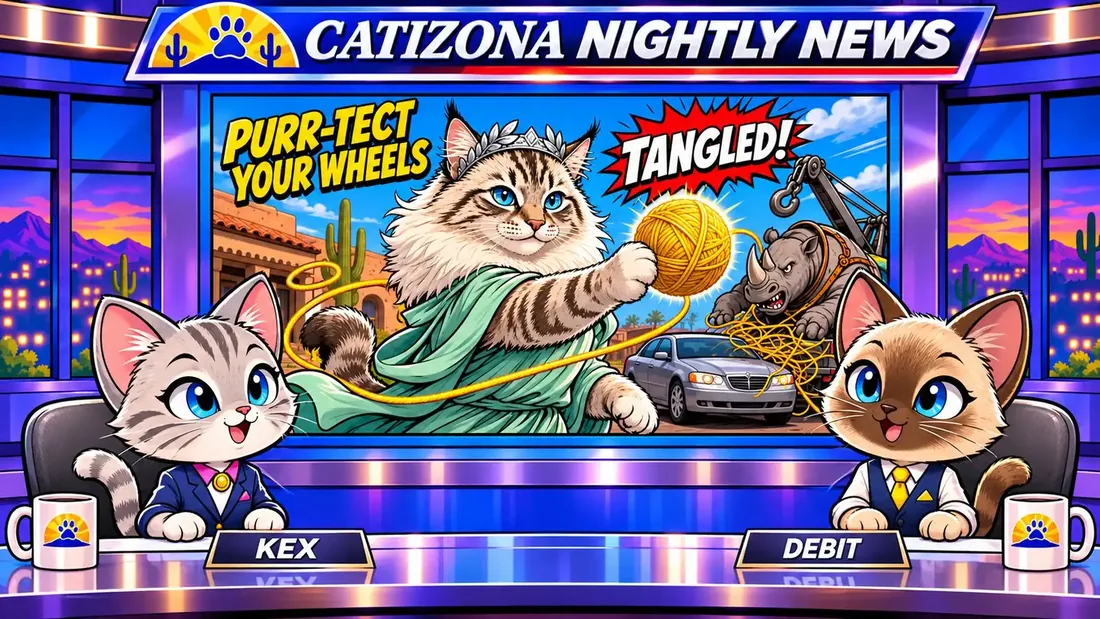
Studio Intro: Breaking News from the Anchor Desk
A rhino, a magnet, and one very determined grandma
(Theme music. The camera pushes in on the studio anchor desk.)
Kex: Good evening, Catizona. I'm Kex.
Debit: And I'm Debit. Tonight's top story: a big rhino, a giant magnet, and one very determined grandma.
Kex: The Repossessor was spotted in a quiet neighborhood early this morning, trying to haul off a family's minivan. Our field reporter Abby is live on the scene. Abby?
Part 1: Live from the Driveway
Behind on payments, and the van started to lift
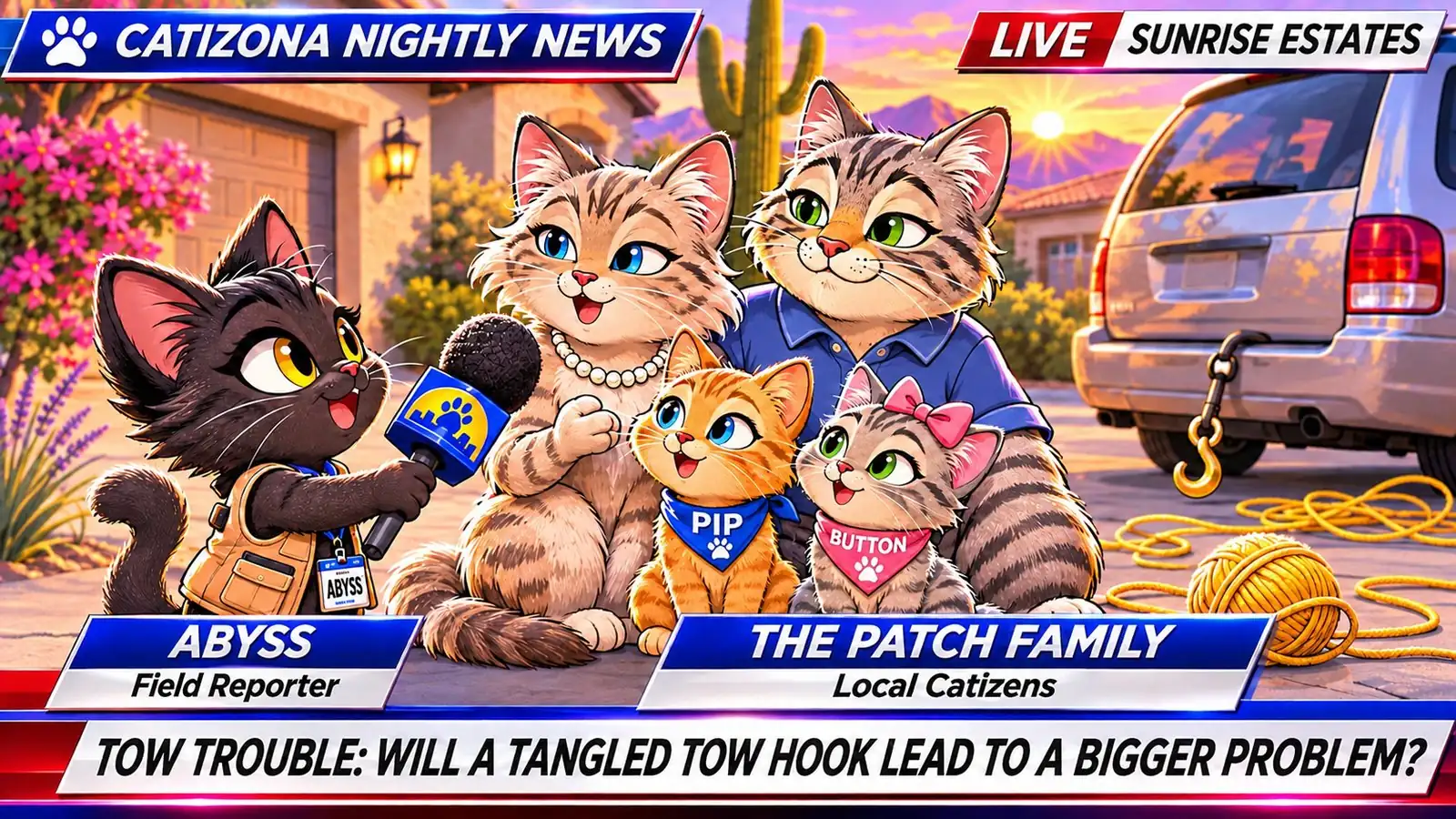
(Cut to a driveway at sunrise. A minivan sits in the driveway with a tow hook dangling off the bumper. Loose golden yarn is everywhere. Abby holds a microphone that's almost as big as she is.)
Abby: Thanks, Kex. I'm standing in the driveway where, just a few hours ago, The Repossessor showed up with his tow truck and his giant magnet. The family who lives here agreed to tell us what happened. We're only using their first names tonight: Mom, Dad, and their two kits, Pip and Button.
Abby: Mom, can you tell us what happened?
Mom: It was still dark. I heard this big clanking noise outside, and then the van started to lift. I ran to the window, and there was a rhino in a red cape with a magnet the size of a hot tub.
Dad: We'd fallen behind on the van payments. My hours got cut over the summer, and we kept thinking we'd catch up next month. Then next month turned into three months.
Abby: That sounds really scary.
Pip: He tried to take Button's car seat too!
Button: And my snacks!
Abby: (very serious) Not the snacks.
Mom: We need that van. It's how we get to work, how the kits get to school, and how we get to Grandma's on Sunday. Losing it would have meant losing a lot more than a van.

Part 2: Wonder Kitten to the Rescue
One phone call, one yarn ball, one tangled rhino
Abby: So what did you do?
Dad: We'd already been talking about bankruptcy, but we kept putting it off because we were embarrassed. When I saw that magnet, I stopped being embarrassed. I called the Bankruptcy Cats.
Mom: And about two minutes later, a little yarn ball came rolling down the street.
(Cut to the family's doorbell camera: a gray blur zips across the lawn after a rolling golden yarn ball.)
Abby: That's Wonder Kitten. She tossed her yarn ball under the tow truck and chased it — around the magnet, around the tow hook, around the rhino's horn, and three times around the truck. Our viewers can see the results behind me.
(The camera pans to The Repossessor, sitting on the curb wrapped up tighter than a winter scarf.)
The Repossessor: This is ridiculous. I'll have this off in a minute.
Abby: Sir, you've been saying that for forty-five minutes.

How Does Arizona Car Repossession Work, and Can I Still Owe Money?
How Arizona repossession works, and why you can still owe money
(Wonder Kitten steps into the shot holding a plate of cookies.)
Wonder Kitten: Hello, dear. Are you hungry? You look hungry. Have a cookie.
Abby: Thank you! Wonder Kitten, viewers want to know: can yarn really stop a repossession?
Wonder Kitten: Oh, goodness, no. Yarn only buys time. The real rescue happens at the courthouse. My human, Jeff, handles that part. I handle the rhino out front.
Abby: Can you explain how it works?
Wonder Kitten: Of course, sweetie. Sit down.
Wonder Kitten: In Arizona, once a car loan is in default, a lender can generally repossess the car without going to court first, as long as it doesn't breach the peace doing it. That's why The Repossessor likes to come in the middle of the night. After the car's taken, the lender usually sells it. If the sale doesn't cover the loan, the lender may come after the family for the difference. That's called a deficiency. So a family can lose the van and still owe money.
Abby: That doesn't seem fair.
Wonder Kitten: That's why I keep the yarn handy, dear.
Can Chapter 13 Stop a Car Repossession and Catch Up on Missed Payments?
Stopping the tow truck and spreading out what's past due
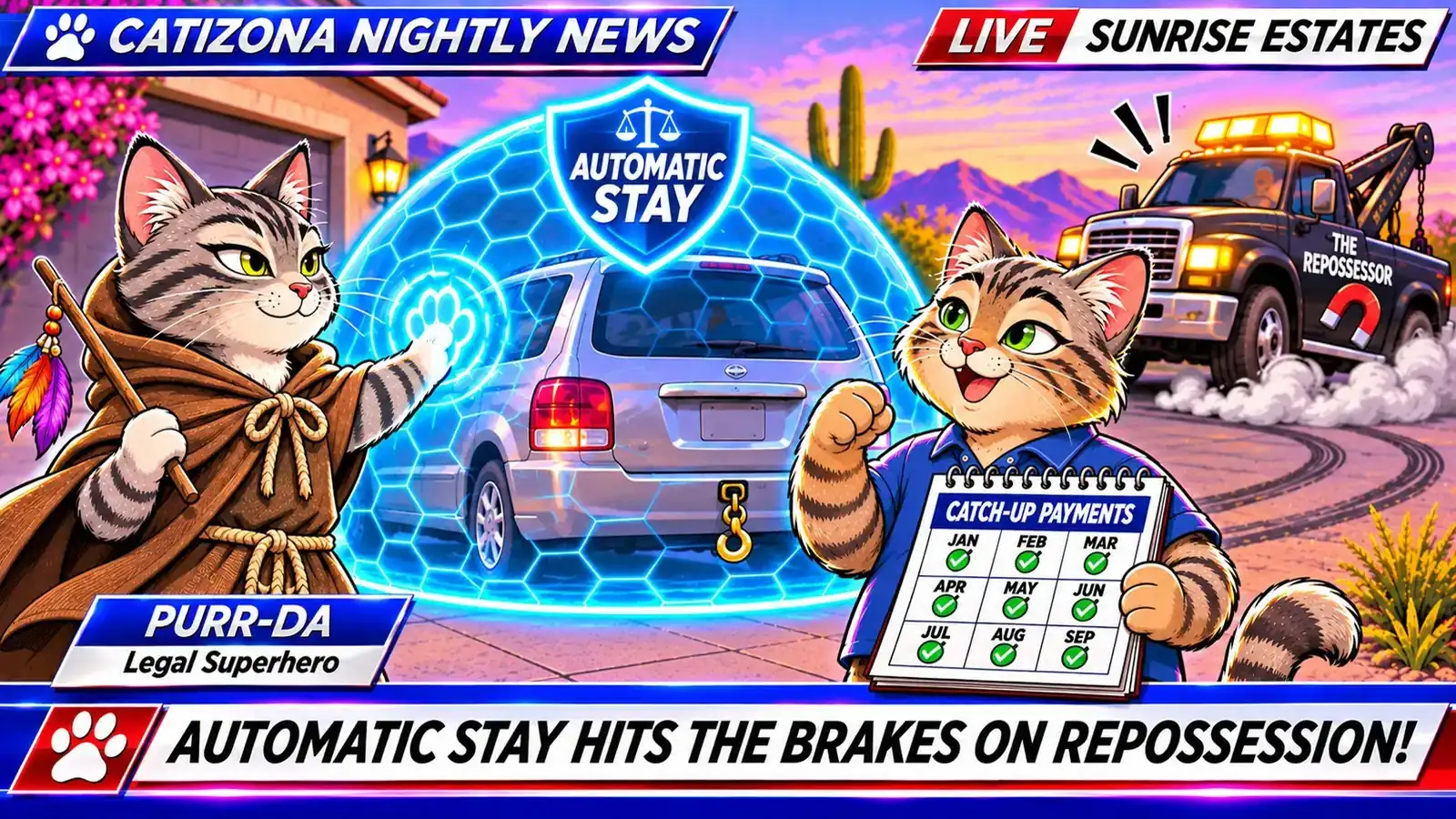
Wonder Kitten: But when a bankruptcy case is filed, something called the automatic stay generally stops a repossession that hasn't happened yet. The lender has to stop. Timing matters, though. The stay starts when the case is filed, not when somebody first thinks about calling a lawyer. So if the tow truck is on its way, call right away.
Abby: And then what? Do they still have to pay for the van?
Wonder Kitten: Usually, if they want to keep it. That's where Chapter 13 comes in. In many cases, a Chapter 13 plan lets a family spread the past-due payments over three to five years while they keep making the regular payment. That's how a lot of families keep their car.
Dad: That's exactly what we needed. We didn't need anyone to make the van free. We just needed time to catch up.
Can Chapter 13 Lower a Car Loan? The 910-Day Rule and In re Penrod
When a car loan can shrink, and when old debt can't ride along
Abby: Can Chapter 13 make the loan smaller?
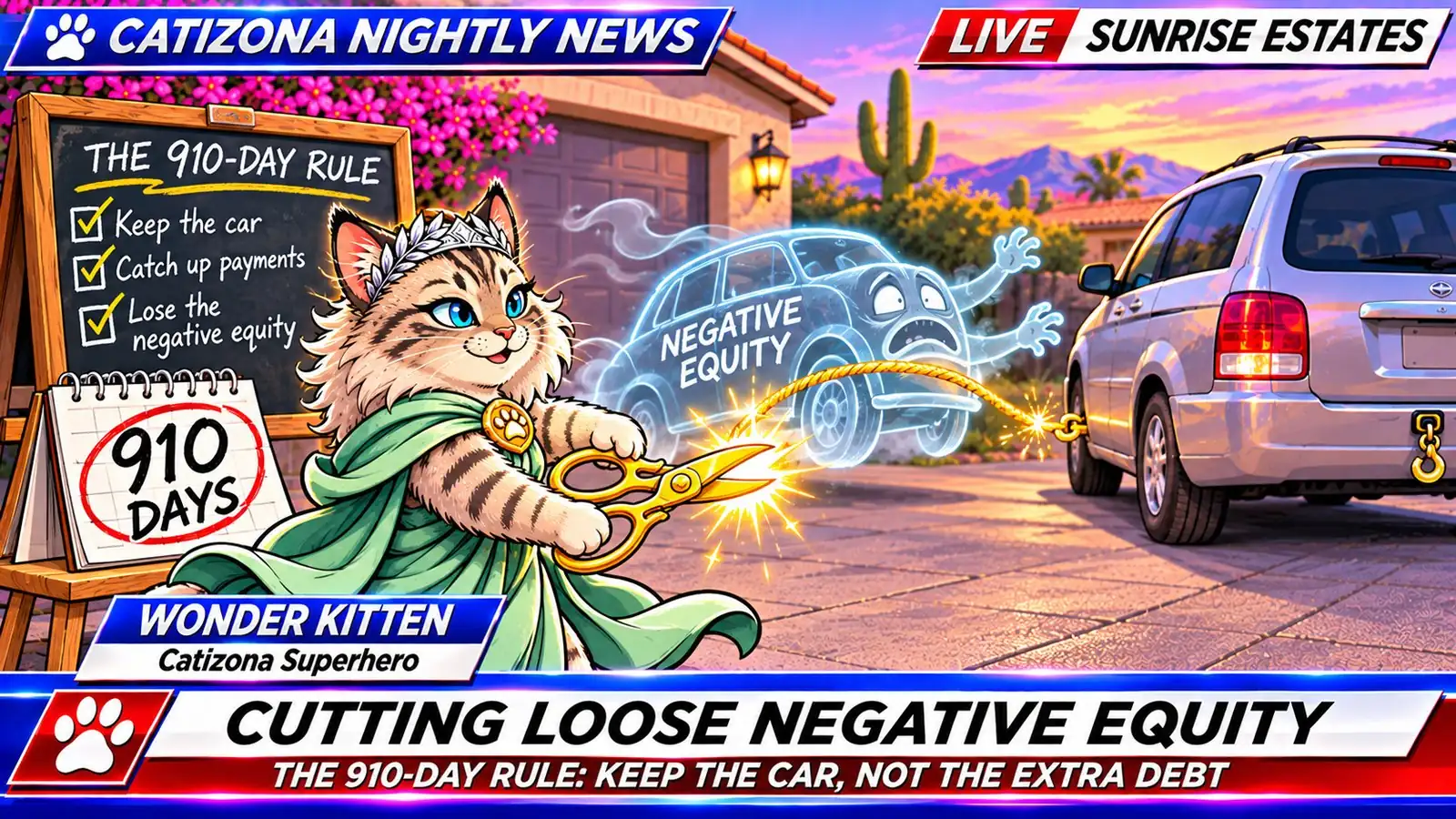
Wonder Kitten: Sometimes, dear, but it depends on when you bought the car. For many car loans taken out to buy a car for personal use in roughly the last two and a half years, about 910 days before filing, Chapter 13 generally can't shrink the loan down to what the car is worth. Families can still often catch up on what's behind, and in many cases the interest rate can be adjusted. If the loan is older than that, the amount paid on it may sometimes be limited to the car's value, with the rest treated like other unsecured debt.
Wonder Kitten: And here's a little secret, dear. Lots of families trade in an old car they still owe money on, and the dealer rolls that leftover balance, the "negative equity," into the new loan. In a case called In re Penrod, the Ninth Circuit Court of Appeals, which covers Arizona, held that the lender doesn't have a purchase-money security interest in that rolled-over negative equity. So even on a newer car loan, the negative equity part generally isn't protected by the 910-day rule and may be treated as unsecured in a Chapter 13 plan.
Abby: So the old car's debt doesn't get to ride along for free?
Wonder Kitten: Exactly, sweetie. Jeff looks at the paperwork first, though, including the sales contract. Nobody should count on a number until he does.

Part 6: Arizona Vehicle Exemption and Car Insurance
The vehicle exemption, insurance, and keeping the plan current
Abby: What about the van itself? Is it protected?
Wonder Kitten: Arizona law protects a certain amount of equity in a vehicle from creditors: about $16,500 for 2026, or $27,500 if you have a disability. That amount adjusts every year. But that protects equity, sweetie. It doesn't take away the lender's lien on the car. Whether any equity is actually there depends on what the van is worth and what's still owed.
Abby: Any rules the family has to follow?
Wonder Kitten: Two big ones. Keep the van insured, and keep up with the plan payments. If the insurance lapses or the payments fall behind, the lender can ask the court to lift the stay, and then he gets back in his truck. (She points at the curb.)
The Repossessor: I heard that.
Wonder Kitten: You were meant to, dear.
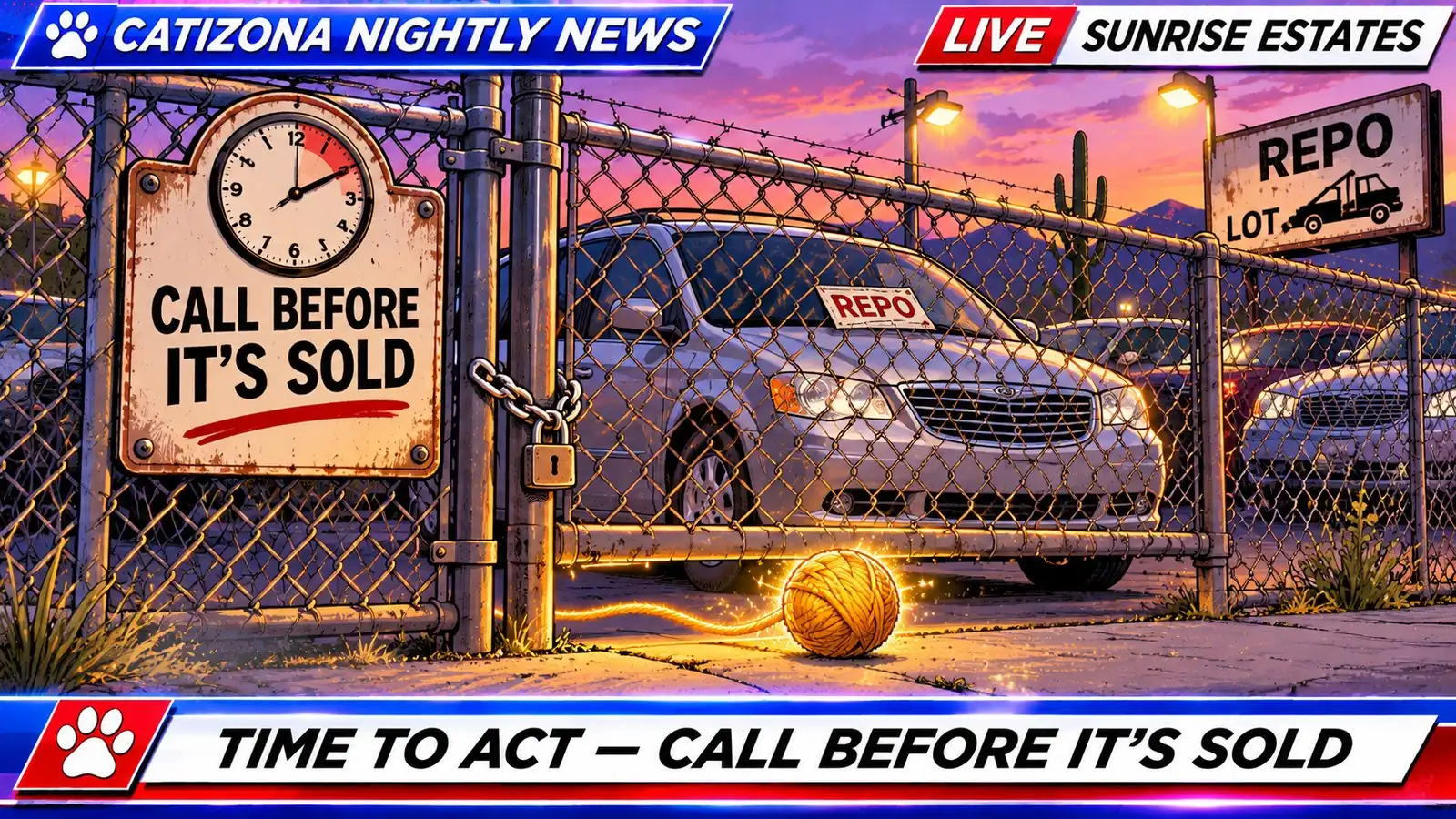
Already Repossessed? Getting the Car Back Before It's Sold
Getting a car back before it's sold, and how Chapter 7 is different
Abby: Wonder Kitten, one more question from our viewers. What if The Repossessor already took the car?
Wonder Kitten: Oh, sweetheart. Breathe, and then move quickly. If a car was repossessed shortly before a bankruptcy filing and hasn't been sold yet, it may still be possible to get it back, often through Chapter 13. Filing doesn't automatically make the lender hand the keys back. But in many cases the court can order the car returned, and some lenders cooperate once a case is filed and they see proof of insurance. Arizona law may also let a borrower redeem the car before it's sold, by paying what's owed plus certain expenses.
Wonder Kitten: The key word is quickly. Call before the car is sold, not after.
Abby: And what about Chapter 7? Would that have helped this family?
Wonder Kitten: Chapter 7 is different. It generally doesn't include a catch-up plan. People who want to keep a financed car in Chapter 7 usually keep paying and may sign a reaffirmation agreement, or sometimes redeem the car by paying its current value in one lump sum. Some people decide to surrender the car and discharge what's left. For a family that wants time to catch up and keep the van, Chapter 13 is usually the first chapter people talk about.

Wonder Kitten's Cheat Sheet
Wonder Kitten: Here's the short version, dear. Every case is different, so call before you decide.
| Question | Chapter 7 | Chapter 13 |
|---|---|---|
| Stops a repo? | Generally, once a bankruptcy case is filed. Timing matters. | Generally, once a bankruptcy case is filed. Timing matters. |
| Already repossessed? | May be able to buy it back by paying its current value in one lump sum, if it qualifies. | If it hasn't been sold yet, you can usually get it back. The lender doesn't have to return it on its own, but once the car is treated in your Chapter 13 plan and insured, lenders typically give it back. |
| Catch up on missed payments? | Generally no catch-up plan. | In many cases, spread what's past due over three to five years while paying the regular payment. |
| Shrink the loan? | Possibly, by redeeming the car at its current value, often with a redemption loan. You'd still have to qualify, and those loans usually carry high interest rates. | Sometimes. If you bought the car more than about two and a half years (910 days) ago, the loan may be 'crammed down' to the car's value. If it's newer, the parts of the loan that didn't pay for the car, like negative equity rolled in from a trade-in, extended warranties, or other add-ons, may still be bifurcated, meaning split off and treated as unsecured. The interest rate may also be lowered. |
| Best for | Keeping the car by paying (maybe a reaffirmation agreement), or surrendering it and discharging what's left. | Families who want time to catch up and keep the van. |

Part 8: Words from the Family
"Don't wait like we did"
Abby: Mom, Dad, what would you tell other families who are behind on their car payments tonight?
Mom: Don't wait like we did. We were so embarrassed, and we didn't need to be.
Dad: Being behind doesn't make you a bad person. It means you hit a bump. Call somebody before the truck shows up.
Button: And hide your snacks.
Abby: Wise words. Reporting live from a driveway that still has a minivan in it, I'm Abby, for the Catizona Nightly News. Back to you in the studio.
Studio Outro: Back to the Desk with Jeff
Don't wait: call a bankruptcy lawyer
(Cut back to the anchor desk. Attorney Jeff Biddle is seated between Kex and Debit.)
Debit: Thanks, Abby. And for the record, the minivan stayed in the driveway, the snacks were recovered, and The Repossessor is still on the curb.
Kex: Joining us at the desk tonight is Jeff Biddle, of Jeff Biddle Law. Jeff?
Jeff: Thanks, Kex. If you're worried your car is about to be repossessed, or if it was recently repossessed, please don't wait. Call a bankruptcy lawyer right away. The sooner you talk to one, the more options you may have. You can reach us at (480) 622-4987, or send the Bankruptcy Cats Signal at BankruptcyCat.com.
Kex: Excellent advice… from an excellent lawyer. I'm Kex.
Debit: And I'm Debit. Good night, Catizona.
(Theme music.)
Wonder Kitten's quick answers
Can Chapter 13 stop a tow truck that's already on the way?
Once a case is filed, the automatic stay generally stops a pending repossession. Timing matters, so call right away.
They already took my car. Is it too late?
Not necessarily, if it hasn't been sold. Act quickly. The court may order the car returned, but the lender doesn't automatically have to hand it back just because a case was filed.
Can I catch up on missed car payments without losing the car?
Chapter 13 may let you spread the past-due amount over the plan while you keep making the regular payment.
Can Chapter 13 lower what I owe on a car loan?
Sometimes. Loans for cars bought in roughly the last two and a half years generally can't be reduced to the car's value, but older loans may be. If negative equity from a trade-in was rolled into a newer loan, the Ninth Circuit's decision in In re Penrod means that part generally isn't protected by the 910-day rule. The interest rate may also be adjusted in many cases.
Do I have to keep my car insured?
Yes, generally. If the insurance lapses or you miss plan payments, the lender can ask the court to end the stay.
If the lender sells my car after a repo, do I still owe money?
Possibly. A deficiency may remain. You may also have the right to buy the car back before it's sold, which is one more reason to call before the sale.
What is the 910-day rule?
A rule about newer car loans. For many purchase-money car loans taken out for personal use in roughly the last two and a half years (about 910 days before filing), Chapter 13 generally can't shrink the loan down to what the car is worth. Families can still often catch up on what's behind, and in many cases the interest rate can be adjusted. Older loans may sometimes be limited to the car's value.
Does filing bankruptcy automatically get a repossessed car returned?
Filing doesn't automatically make the lender hand the keys back. But in many cases the court can order the car returned, and some lenders cooperate once a case is filed and they see proof of insurance. If a car was repossessed shortly before a bankruptcy filing and hasn't been sold yet, it may still be possible to get it back, often through Chapter 13.
Chapter 7 vs. Chapter 13 if I want to keep my car?
Chapter 7 generally doesn't include a catch-up plan. People who want to keep a financed car in Chapter 7 usually keep paying and may sign a reaffirmation agreement, or sometimes redeem the car by paying its current value in one lump sum. For a family that wants time to catch up and keep the van, Chapter 13 is usually the first chapter people talk about.
Wonder Kitten's checklist
- Your loan paperwork and the lender's name
- Every notice you've received (keep them all, dear)
- Your insurance card
- Your last few pay stubs
- The car's year, make, model, and mileage
- About when you bought the car (that two-and-a-half-year window matters)
- Your sales contract, especially if you traded in a car you still owed money on
Is The Repossessor circling your driveway? Call Jeff Biddle Law at (480) 622-4987, or send the Bankruptcy Cats Signal at BankruptcyCat.com.

Flare Explains
Flare, Ember's kitten, breaks down the big words.
Repossession: When a car lender takes the car after a loan defaults. In Arizona, a lender can generally do that without going to court first, as long as it doesn't breach the peace.
Deficiency: The leftover balance the lender may still try to collect after it sells a repossessed car for less than what was owed. A family can lose the van and still owe money.
Automatic stay: An order that starts the moment a bankruptcy case is filed and generally stops a repossession that hasn't happened yet. Timing matters: it starts when the case is filed, not when somebody first thinks about calling a lawyer. It doesn't make the debt go away, and if the car was already repossessed, the stay alone generally doesn't force the lender to hand it back.
Chapter 13 plan: A three-to-five-year repayment plan in a Chapter 13 case. In many cases it lets a family spread past-due car payments over the plan while they keep making the regular payment.
910-day rule: A rule about newer car loans. For many purchase-money car loans taken out for personal use in roughly the last two and a half years (about 910 days before filing), Chapter 13 generally can't shrink the loan down to what the car is worth. Families can still often catch up on what's behind, and in many cases the interest rate can be adjusted. Older loans may sometimes be limited to the car's value.
Negative equity: The leftover balance still owed on a trade-in car that a dealer rolls into the new car loan. In In re Penrod, the Ninth Circuit (which covers Arizona) held that the lender doesn't have a purchase-money security interest in that rolled-over amount, so that part generally isn't protected by the 910-day rule and may be treated as unsecured in a Chapter 13 plan.
Bifurcated: Split into two parts. In Chapter 13, a car loan can sometimes be split into a secured part (the car's value, or the part that actually paid for the car) and an unsecured part (the rest). That unsecured part can include things like trade-in negative equity, warranties, or other add-ons financed into the loan. The secured part gets paid in the plan; the unsecured part is paid like other unsecured debts, often only partly. It does not always happen, and it does not guarantee savings.
Purchase-money security interest: A security interest that secures the money used to buy the car itself. The 910-day rule only protects that kind of interest. Rolled-in negative equity from a trade-in generally isn't purchase-money.
Vehicle exemption: Arizona law that protects a certain amount of equity in a vehicle from most creditors: about $16,500 for 2026, or $27,500 if you have a disability (CPI-computed; adjusts every year). It protects equity; it doesn't take away the lender's lien.
Secured claim: A claim backed by collateral, like a car loan backed by the car. In Chapter 13, how that claim is paid depends on the plan, the car's value, and rules like the 910-day rule.
Relief from stay: When the court ends the automatic stay so a lender can repossess again. Lenders often ask for this if insurance lapses or plan payments fall behind.
Redemption (Arizona UCC): A borrower's right, before the lender sells a repossessed car, to get the car back by paying what's owed plus certain expenses. Separate from bankruptcy. Call before the car is sold.
Reaffirmation agreement: In Chapter 7, a written agreement to keep paying a car loan so you can keep the car. Chapter 7 generally doesn't include a catch-up plan like Chapter 13.

Pebbles of Information
Rocky, the firm's research cat, dug up where all of this comes from.
- Arizona self-help repossession (no court first, if no breach of the peace): A.R.S. § 47-9609(A)–(C).
- Deficiency after a repo sale (disposition + deficiency liability): A.R.S. §§ 47-9610 and 47-9615 (especially § 47-9615(D)(2)). Consumer pre-sale notice: § 47-9611 and § 47-9614. (No § 47-9626 in this short pebble.)
- Redemption before sale (pay the full debt plus certain expenses): A.R.S. § 47-9623.
- The automatic stay (the stop): 11 U.S.C. § 362(a). Relief from stay for cause (including lack of adequate protection): § 362(d)(1).
- Keeping a repossessed car without handing it back is not, by itself, a stay violation under § 362(a)(3): City of Chicago v. Fulton, 592 U.S. 154 (2021). Turnover may still be available under § 542(a); since Dec. 1, 2024, an individual debtor can often seek turnover of a car by motion under Fed. R. Bankr. P. 7001(a).
- Curing car-loan defaults through the plan while keeping up regular payments: 11 U.S.C. § 1322(b)(3) and (b)(5); cure amount § 1322(e); plan length § 1322(d).
- Modifying a car loan / limiting the secured claim to value: § 1322(b)(2) and § 1325(a)(5), with § 506, unless the 910-day hanging paragraph after § 1325(a)(9) applies (purchase-money security interest; debt incurred within 910 days before filing; motor vehicle acquired for the debtor's personal use). Elements list: In re Trejos, 374 B.R. 210 (B.A.P. 9th Cir. 2007).
- Negative equity rolled in from a trade-in is not purchase-money under the hanging paragraph: In re Penrod, 611 F.3d 1158 (9th Cir. 2010).
- Present-value interest on a modified car claim (no D. Ariz. "standard" rate quoted here): Till v. SCS Credit Corp., 541 U.S. 465 (2004); § 1325(a)(5)(B)(ii).
- Arizona motor vehicle exemption, $16,500 in one vehicle (about $27,500 with a qualifying disability): A.R.S. § 33-1125(8). Protects equity; does not wipe the lender's lien.
- Chapter 7 redemption of personal property: 11 U.S.C. § 722. Reaffirmation: § 524(c). (No day-count deadline quoted.)

The Catizona Nightly News, its anchors, its reporter, and the family in this story are made-up cats, not lawyers, and not real clients. This post is general information, not legal advice, and every situation is different. Contacting us by email or phone does not create an attorney-client relationship, so please don't include confidential details. Attorney advertising. Jeff Biddle Law, Chandler, Arizona. We are a debt relief agency. We help people file for bankruptcy relief under the Bankruptcy Code.