
From the Catizona Nightly News studio, Kex and Debit are at the anchor desk. Behind them, the package graphic shows Athena in a navy blazer and pearls, a courthouse, the scales of justice, and the words LOCAL CAT GETS HER DAY IN COURT.
Kex: We open tonight with a story a lot of Catizona gets wrong. People hear "341 meeting of creditors" and think a local cat is getting her day in court.
Debit: That is what our graphic says. A courthouse. A judge. A gavel. A hallway full of angry creditors.
Kex: Athena is Jeff Biddle Law's client relations cat, and she has been to these meetings. Flare Embridge is live at her house. Flare, go.
Hi, it's me, Flare! I combed my whiskers, packed my notebook and my camera, and I am LIVE at Athena's house. I am Flare Embridge, whipper-snapper young field reporter for Catizona Nightly News.
"Hi! I'm Flare, from Catizona Nightly News," I said, and I held up my press pass.
"Actually, it's not court!" I said, because the desk graphic had a courthouse and a day-in-court headline, and I had to get the true part out first. I wrote that part down twice.

I found Athena stretched out on a pool chaise, sunglasses on, about as relaxed as a cat can get. I held up my mic. It has a news logo on it. I also have a PRESS badge. I checked. When I asked how she stays so calm about something called a "meeting of creditors," she said it's simple. She's seen them in real life.
Athena has shown up at meetings of creditors without filing a petition, taking an oath, or putting on a suit. Usually she just walks in front of Jeff's camera. Sometimes he picks her up and introduces her to everyone.
"I went to claw school and received my Doctorate of Fluff," Athena explained. "Jeff handles the legal advice. I handle being fluffy."
People who have never been to one often picture something out of a TV courtroom, with a judge, a gavel, and a room full of angry creditors. That's not what Athena has seen. The meeting of creditors, also called a 341 meeting, isn't a court hearing. There's no judge. A trustee asks about your bankruptcy papers, property, debts, income, and expenses, and creditors can ask questions too.
It can feel a lot less scary than the name sounds. But you're still under oath, which means you promise to tell the truth. Even a surprise cat introduction doesn't change that part. I wrote that down twice too.

We moved inside to Athena's kitchen, where she held up a stack of papers to make her point. There was a big video camera in the kitchen too. Her advice starts long before anyone turns on a camera. Give Jeff the completed questionnaire and the documents requested for your case. These can include copies of your Social Security card and driver's license, pay stubs, bank statements, and tax returns.
Use the firm's secure delivery instructions for sensitive documents. Your meeting notice and the trustee's instructions explain identification requirements, and if an identification document is missing, tell Jeff early.
(The cans of cat food on the counter are not on the document list. I checked.)

Here's the part that surprises people most. I stepped back so you could see it the way Athena showed me: just her, on the sofa, with her phone. The meeting isn't held at the courthouse. It happens by Zoom. You can join from your car, from work, or while relaxing on the sofa, the way Athena showed me in her living room.
There's one catch: you do have to appear on camera. Check your notice for the connection details, test your camera and sound ahead of time, and find a spot where you can hear and be heard.
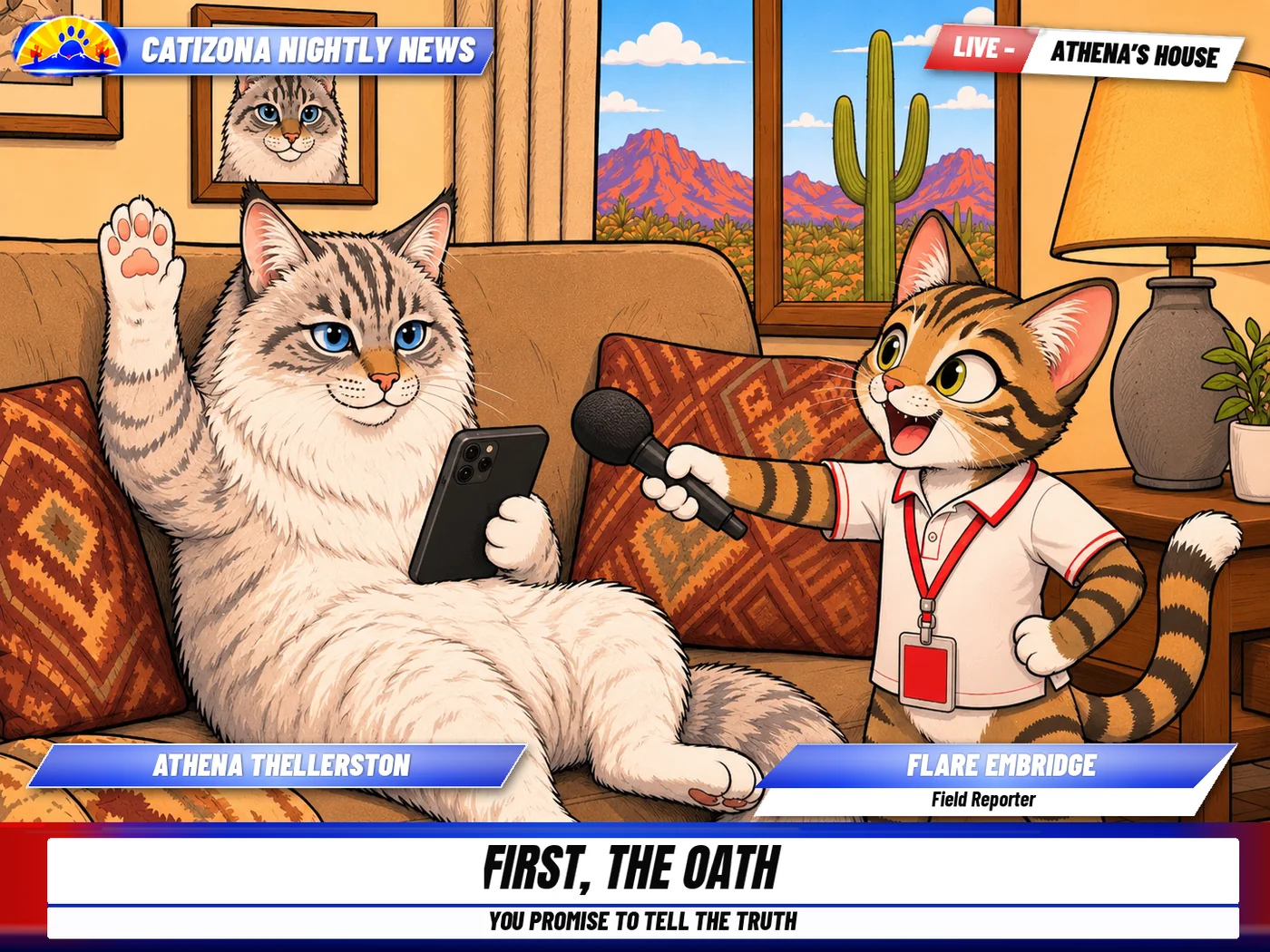
Then Athena raised her paw, still holding her phone, and I knew we'd reached the serious part. I held up my mic again. To put some specifics behind all that reassurance, Jeff supplied a sequence he heard in this exact order at five meetings in one day. Below are those twenty items, beginning with the oath. They are not questions from our interview.
Every trustee and case can be different. This is an observed list, not a universal checklist or a full statement of eligibility, disclosure, or tax-filing rules. Its time periods are the ones asked that day. Ask Jeff about your circumstances rather than memorizing answers.
- The trustee will have you take the oath and then ask you if you just took the oath. They start with an easy question, for sure.
- Is your address correct?
- Did you reside in Arizona for the 90 days prior to filing this case?
- Have you lived in Arizona for 2 years?
- Have you filed bankruptcy in the past 8 years?
- Have you filed bankruptcy using a different social security number?
Yes, the opening item really does ask whether you just took the oath. That's a manageable start, even without a Doctorate of Fluff.

Back at the kitchen table, I could practically see the words "assets" and "debts" floating over Athena's head. I got my notepad out and wrote it all down. That's where the trustee goes next, from your background to the papers filed in your case. Your petition starts the bankruptcy case. Your schedules list financial information, including what you own and what you owe.
- Did you read and sign the petition and schedules filed for you in this case?
- Is the information in the petition and schedules true and correct?
- Did you list all of your assets?
- Did you list all of your debts?
- Have there been any changes since filing?
Reading those papers beforehand gives you a chance to spot mistakes, missing information, or changes. Tell Jeff if you find any. The goal isn't to guess what the trustee wants to hear or put on a perfect performance. It's to give accurate answers about your situation. Athena's camera experience may involve strolling across the picture. Your preparation involves knowing what's on the pages.

Then I leaned in with my big question: "Inheritance?" I even put a pencil behind my ear so I would look very, very serious. Athena had a will right there on the kitchen table.
The next part of Jeff's sequence covers inheritances and the identifying information on the court notice. A beneficiary is someone entitled to receive something under a will or trust.
- Are you the beneficiary of a will or trust?
- Have you waived your right to inherit any money in the last 6 years?
- Have you inherited any money in the last 3 years?
- Is your social security number correct as it appears on the 341 notice from the court?
If you're not sure whether something counts as an inheritance or an interest in a trust, bring it up with Jeff before the meeting. Don't leave him, or yourself, guessing. If the court notice has an identification error, let him know promptly and follow his instructions for correcting it securely.
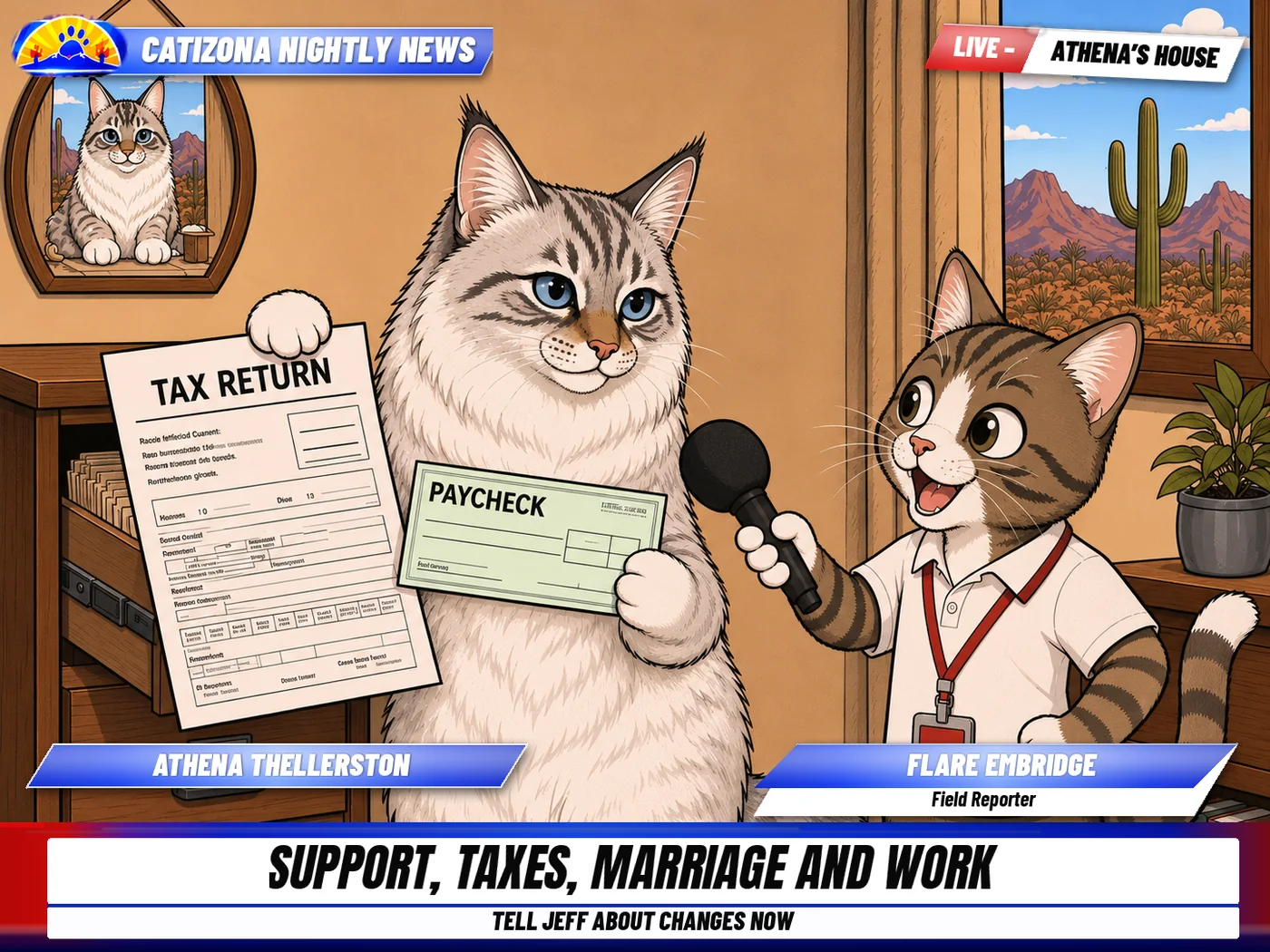
In her home office, Athena went straight to the filing cabinet and pulled out a tax return and a paycheck stub. She held them up for my mic. That was her way of introducing the last group in that day's sequence, which covers household and financial basics. The questions are direct, but the answers can reveal something Jeff needs to address before the meeting.
- Do you have any domestic support obligations like child support or alimony?
- Are you current on those obligations?
- Have you filed your last 2 years of federal and state income tax returns?
- Are you married?
- Are you employed? If so, what is the address of your employer?
A missing tax return, a support payment that's behind, or a job change is something to tell Jeff about now. Waiting until the meeting won't make it easier to explain. He needs the real picture to help you prepare, not a tidied-up version for the camera.
After the standard questions, the trustee may ask about your specific case and documents. A large bank transaction, a loan repayment, or a property transfer might need explaining. Jeff sees these follow-ups more often in Chapter 7 than Chapter 13, but they can happen in either.
A question isn't automatically an accusation. Listen, answer honestly, and say so if you don't understand or don't know. There's no prize for confidently guessing. (I asked. There really isn't.)

The trustee also checks whether any creditors are present with questions. Athena and I grabbed binoculars and searched her whole office just to be thorough. Athena got VERY excited about this part. We looked and looked. We didn't find a single one.
That matches Jeff's experience. He reports that fewer than ten creditors appeared at his meetings over a fifteen-year period. That's his historical experience, not a prediction about yours. Creditors have the right to attend and ask questions, and one showing up doesn't automatically mean something has gone wrong. For a meeting named after creditors, that may be the most reassuring detail in my whole report.

For my last stop, Athena gave me a tour of her closet, and she answered the wardrobe question in a ball gown and a crown. We both laughed so hard I almost dropped my mic. Then she got serious: humans should wear clothes, but not these.
"Dress like you're going to Walmart," she said.
Ordinary, comfortable everyday clothes will do. There's no need for a suit, a runway outfit, or a fur coat to match hers. Hers is attached. Yours can stay in the closet.
Still standing in her closet, crown slightly crooked, Athena summed it all up. The meeting is less like a mysterious courtroom event and more like something you can prepare for. Get Jeff the requested documents securely. Read your papers. Follow your notice. Answer honestly, and speak up about anything missing, wrong, or unclear.
"You don't need a Doctorate of Fluff to do that," she said.
No special degree. No runway wardrobe. Just preparation, truthful answers, and Jeff's help with the legal questions. Athena may supply the occasional camera cameo, but that part isn't on the checklist.
Reporting from Athena's closet, this is Flare Embridge, Catizona Nightly News. I have to run home and tell my dad EVERYTHING! Back to the desk.
Kex: Thank you, Flare.
Debit: That's Catizona Nightly News from Athena's house. A 341 meeting is not court, and there is no judge. Get Jeff the documents, read your papers, follow your notice, and answer honestly.
Flare Embridge reports for Catizona Nightly News. Preparing for a meeting of creditors in Arizona? Reach out to Jeff Biddle Law (and the Bankruptcy Cats). Call or text (480) 622-4987, or visit bankruptcycat.com. Already working with Jeff? Contact him before the meeting with questions or changes.
Quick answers about the 341 meeting
Is a 341 meeting of creditors a court hearing?
The meeting of creditors, also called a 341 meeting, isn't a court hearing. There's no judge. A trustee asks about your bankruptcy papers, property, debts, income, and expenses, and creditors can ask questions too.
What documents should I give my attorney before a 341 meeting?
Give Jeff the completed questionnaire and the documents requested for your case. These can include copies of your Social Security card and driver's license, pay stubs, bank statements, and tax returns. Use the firm's secure delivery instructions for sensitive documents.
Is the 341 meeting held at the courthouse?
The meeting isn't held at the courthouse. It happens by Zoom. You can join from your car, from work, or while relaxing on the sofa. You do have to appear on camera. Check your notice for the connection details, test your camera and sound ahead of time, and find a spot where you can hear and be heard.
Do creditors usually come to the 341 meeting?
Jeff reports that fewer than ten creditors appeared at his meetings over a fifteen-year period. That's his historical experience, not a prediction about yours. Creditors have the right to attend and ask questions, and one showing up doesn't automatically mean something has gone wrong.
What should I wear to a 341 meeting?
Ordinary, comfortable everyday clothes will do. There's no need for a suit, a runway outfit, or a fur coat. As Athena put it: dress like you're going to Walmart.

Flare Explains
Flare, Ember's kitten, breaks down the big words.
341 meeting: The required meeting where the trustee asks about your bankruptcy information under oath. No judge presides.
Under oath: You promise to tell the truth.
Trustee: The person who conducts the meeting and administers the bankruptcy case. The trustee isn't your attorney.
Assets: Things you own or have a financial interest in.
Domestic support obligations: Obligations such as child support or alimony.

Pebbles of Information
Rocky, the firm's research cat, dug up where all of this comes from.
- The meeting: 11 U.S.C. § 341, especially § 341(c) (no judge attends), and § 343 (the debtor testifies under oath).
- Where you can file: 28 U.S.C. § 1408 (the 180-day test, which is separate from the exemption clock).
- Which exemptions apply: 11 U.S.C. § 522(b)(3)(A) (usually 730 days in Arizona, with a 180-day fallback after a move) and A.R.S. § 33-1133 (Arizona's opt-out). Cases: In re Shiu Jeng Ku (B.A.P. 9th Cir. 2017, unpublished), In re Rody, 468 B.R. 384 (Bankr. D. Ariz. 2012), and In re Wood (Bankr. W.D. Ark. 2007).
- Tax returns: 11 U.S.C. § 521(e)(2) and Fed. R. Bankr. P. 4002(b)(3) (latest federal return to the trustee at least 7 days before the meeting), plus § 1308 in Chapter 13 (the last 4 years).
- Inheritances: 11 U.S.C. § 541(a)(5) (one you become entitled to within 180 days after filing belongs to the estate).
- Zoom meetings in Arizona: U.S. Trustee Region 14 and the court's May 3, 2024 notice.
- Arizona local rules: LR 2003-1 (continuances and waivers) and LR 2003-2 (the Chapter 7 questionnaire and document checklist). For Chapter 13: LR 2084-7 (continued meetings), LR 2084-27 (redaction), and LR 2084-5 (tax returns).

Where this comes from
The twenty-item sequence and Athena's camera cameos come from Jeff's account. The creditor-attendance figure is Jeff's historical experience. General meeting and preparation information: U.S. Trustee Program, Section 341 Meeting of Creditors. Legal framework: 11 U.S.C. §§ 341 and 343. Follow your meeting notice and trustee's instructions for attending and preparing.